Why do some teams click while others never quite gel?
Get a practical way to stop communication breakdowns and strengthen your team.
40+ years of research into the language teams use to work, decide and deliver together. In the early 1990s Dick McCann and Charles Margerison set out to answer one question. Why do some teams click and achieve great results while others fail, even when they start with the same promise?
The answer became the Margerison-McCann Types of Work Wheel and Team Management Wheel, the twin models at the heart of Team Management Systems. Together they give teams a shared language for the eight types of work every team performs and the eight role preferences people bring to that work.
- Map the eight types of work every team needs to perform.
- Identify the role preferences driving how people show up at work.
- Give your team a shared language it can use from day one.
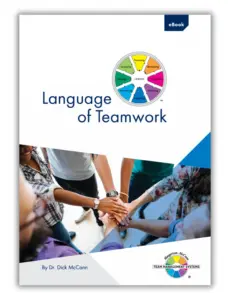
Download the Language of Teamwork ebook for building one shared language in your organisation and the teams you support.
The Language of Teamwork
Download the ebook and build one shared language in your organisation.
What’s inside the ebook
- The story behind the language of teamwork, developed by Dick McCann and Charles Margerison from interviews with managers across a large number of industries.
- The Types of Work Wheel: the eight work functions every team performs, with Linking at the centre.
- The Team Management Wheel: the eight role preferences, from Reporter-Adviser through to Upholder-Maintainer.
- The four RIDO work preference measures (Relationships, Information, Decisions, Organisation) and how they shape behaviour at work.
- An introduction to the Linking Leader Model and its 13 linking skills.
- Real-world case studies.
- How the models accelerate teams past Tuckman’s storming stage into performing.
Why this matters for HR and L&D leaders
Teams that share a language move through storming faster. Tuckman is familiar territory for HR, but the practical question is always the same: how do we get this team to performing sooner? The Language of Teamwork gives HR and L&D a vocabulary the team can actually use, one that underpins onboarding, team design, leadership development, career planning and performance review. Where generic communication training teaches technique, the Margerison-McCann models explain why certain approaches land with some people and miss others.
Why this matters for consultants and facilitators
The Types of Work Wheel and the Team Management Wheel are practical tools consultants use with client teams in the room. The ebook walks through real examples, including a computer company Board where 140 unresolved issues dropped to under 20 once the team adopted the language.
The TMS principle behind the model
“We tend to practise what we prefer and become more proficient in our preferred areas. This in turn gives us pleasure from our work.”
This is the four-P logic at the heart of TMS: Practise, Prefer, Proficient, Pleasure. It explains why role preferences, once understood, consistently predict where people will thrive and where they will struggle.
Who this ebook is for
- HR and L&D leaders designing team effectiveness, onboarding or leadership development programs.
- Team leaders wanting a shared language to diagnose how their team works and how they can work better.
- Consultants, coaches and facilitators running team interventions.
- Leaders of cross-functional or project teams that need to perform quickly.